Thursday, January 15, 2009

Three New Moons in Mali

When I see them through the glass at the airport, it really hits me. Eighteen months is a long time. My first glimpse is of my dad’s halo of white hair floating above a see of dark skin in the baggage claim. The halo shimmers like a ghost, prickling my skin with the awareness of passing time. I let my eyes pull focus to my own reflection in the glass, and I study the transparent image fixed in the foreground. My hair is streaked with blond, my arms are less muscular, but I can’t detect any signs of time. Then the halo passes behind my own image, my focus racks back, and I pull in a sharp breath of air. Time passes whether we see it or not, and we are, each of us, just impermanent wisps of life that breathe and live and love and then blow out. 


So when the halo comes bursting out of the airport doors I leap from my reverie and go clasp my arms around the very real, the very physical wisp of life in front of me. I hold my dad, my mom, my brother. I look at their faces, and for the first time in 18 months I see a reflection. My brother smiles and I see my own dimples.  I think seriously for the first time about what it means to share the same blood. It means a lot. 


                          ******

The Lunas stayed for one moon. It was an adventure, a reunion, a recharging, a time of laughter and great learning for all. I remember the first day in Bamako, my dad said, “I just couldn’t imagine it. No matter how many pictures or letters you sent, I just had no idea it was like this.” Yeah. It’s probably dirtier, more polluted, more hectic than I could describe. Alongside women with giant loads of bananas stacked on their heads, herds of goats and cattle weave through the dusty chaos of motorcycles and donkey carts and battered taxis. It’s a hard scene to imagine.


Our welcome in M’Pedougou, my village, was nothing short of spectacular. I called ahead of time to warn of our arrival, and when we pulled up on the road, it was to the sight of 200 people crowded on the roadside. They drummed and sang and did their best to utterly overwhelm the new arrivals. Soon enough the drummers let us unpack and promised that sini, tomorrow, there would be more. Sini, we gathered in the center of village, next to the old mango tree, to dance for hours to balafon music. My mom and dad, who are old-time cloggers, showed off some fancy moves to the delight of the villagers. Each family member was presented with a beautiful bogolan mudcloth, and we received three chickens. The next day my women’s group members came by with a mountain of peanuts. I was taken back with their generosity – their willingness to give the small amount that they have in a gesture of thanks to me and to my family.


The next day, while my brother suffered through a painful (first) bout of giardia, my neighbor Yaya invited us over to weigh his sorghum trial results. Here it was, the final result of the project I’d been working on all year. We had started in March, holding meetings to discuss the scientific research process and to figure out who was doing what, where, and how. I acquired four new varieties of sorghum seed in Bamako at a research station and divvied them up between five farmers. Each farmer was to plant five small plots, one of each new variety and then the local variety as a control. From five farmers, four planted. From four planted, three sprouted (one got eaten by termites). From three sprouted, two survived to maturity (one got eaten by cows). From two mature stands, one got measured (one got damaged by birds). And this was Yaya’s. Yaya, my shining light in M’Pedougou. Yaya only finished fourth grade, but his intelligence, creativity, work ethic, and beaming smile have brought him far in life. Needless to say, I was nervous as we collected the dried up bundles of sorghum and Yaya’s wives started beating the seed off the stalks. I know research is supposed to be “impartial,” but I couldn’t help but hope that all this work might amount to some small opportunity for improvement. The scales gave me an early Christmas gift. The local variety weighed in at 3kg, and one of the new varieties at 5kg, a substantial increase. It was exciting to see positive results, and even better that my dad (himself an agricultural researcher) could be there to see it. 


Through the course of our trip, I got to watch my family go through a mini version of the journey I’ve been on for eighteen months. It starts with shock: complete sensory overload. As the shock wears off, it transitions into wonder and excitement, maybe romanticism. As I experienced it, there follows a period of enthusiasm and new ideas, and then as the ideas are suggested and tried and don’t work, or tried and abandoned, or simply not tried, a layer of dust settles on the preliminary enthusiasm. My dad started out full of ideas – like why don’t they have longer handle hoes instead of these short ones that hurt their backs? Answer: they just don’t do it that way. I too started out chock full of ideas, and over time I haven’t lost these ideas, but I have a better idea of why, in fact, things are done the way they are. Tradition. Inertia. Cultural differences. And many reasons that we can’t see at all.


As Americans we are programmed to experiment, to innovate, to improve, to distinguish ourselves. Individuality is prized. Here, people are programmed to do things the way their community has been doing them for a long time. They are taught the values of family cohesion and community. Tasks are accomplished by working together and working hard, and few people stop to think, hey if I did this differently, I could make this task more efficient and potentially reap a greater benefit. Take, for example, the Malian belief that when someone has more than someone else, they should share it. To a Westerner, it means people have no incentive to innovate or do better or work harder because they will just have to give their profit to their family or friends. It sounds like bad capitalism. In Mali, it means that in even one of the poorest countries in the world, very few people are left to fall through the cracks.


As I have gradually become aware of these differences, I haven’t lost “hope,” but I have a greatly altered perspective on development, in particular the pace at which it can and should happen. In my dad’s one month in Mali I saw him jerk through this process of paradigm shifting, wondering why change was so difficult. It would be easy to fall into simple criticism or cynicism or both, but I think the bridge across those two dangerous pits lies in opening the mind beyond culturally programmed beliefs about the way society should work.  Recognizing how complicated this puzzle is, I have started letting go of my attempts to “change” people or things. I am not here to force anything on anybody. I’m here to exchange ideas, to give people opportunities if they are interested in them, and to be an American ambassador of peace and friendship. 


Wednesday, October 29, 2008

Marathons of feet and mind

PHOTOS at http://www.facebook.com/album.php?aid=2303541&l=2c663&id=3408340


the ACCRA INTERNATIONAL MARATHON

When my alarm wrenches me from sleep, I lay for a moment relishing the pleasures of a soft bed. What the -- am I doing? On the nightstand is a white square of sheeny paper (like money, it doesn’t tear) with the number 546 on it. I get up, and I’m already dressed: in the one pair of (knee-length-for-modesty) running shorts I came to Africa with, and the pale orange wicking t-shirt that, by the looks of it, won’t be wicking for much longer. I sit in the dark and pull on my grubby running shoes, who also look like relics from war. Why, I ask myself, do human beings, or some of them anyway, choose to engage in activities that they know will be difficult, painful, in fact, down right dreadful? I’m about to run the Accra International Marathon in the capital city of Ghana (south-east of Mali), sandwiched by the Ivory Coast and Togo, and I have to ask myself again what it’s all about.

When I was “training” in Mali, battling bouts of intestinal amoebas (which seem to be a permanent fixture for me), fevers, and herds of cows, I thought about it too. I run in the late afternoon, when the worst of the heat has abated, and people are beginning to come home from the fields. I run out into the ‘bush’ as they call it in French, past fields of corn and sorghum glowing gold, through herds of cows and goats in search of pasture, and … of course, past the people. The women appear as bright splashes of color, their heads loaded with giant baskets or bowls overflowing with the day’s harvest and carefully tied bundles of firewood. From their bright plastic flip flops, to the striped fabric wrapped as for skirts and the equally brilliantly patterned shirts that invariably slip off one shoulder, their bodies glide forward, the necks moving slightly in barely perceptible weaves, left, right, left, right, as they effortlessly balance their loads and chatter and bob their way home. Our paths cross. Their steps are those of exhaustion after a day’s labor, and mine are those of an American in my fancy running shoes, my knees showing, my sunglasses glinting in the sun. We greet and inquire about families, bless the remainder of the day, and continue on. I can’t help but feel a ball of guilt lodge in my throat. Here I am, with such excess energy that I not only can, but I choose, to go running for some ungodly reason. In a place where never-ending back-breaking labor is the norm, the word for happiness or well-being is one and the same as “rest.” Lafine. They don’t need to supplement their lives with extra labor, and they can’t understand why I would choose to do so if I didn’t have to.

So at 3am my friend Bess and I load into a shuttle that will take us to the starting line, 42k, 26.2 miles outside of Accra. There are at least a dozen Peace Corps Volunteers from around West Africa, and we swap stories of training for a marathon in the climactic and nutritional conditions of the Sub-Sahara. We spend at least an hour in the shuttle trying to find the starting place, and when we unload we are alone, until 4:30 when another group arrives. Just as the sky is starting to turn a dark gray purple, someone comes and tells us to walk down the road to the starting line. So the group strings along down the road, everyone muttering about where the start line is, and we walk for what seems like a mile, maybe longer, everyone counting every step as one extra they shouldn’t have had to take in addition to 26.2 miles. Finally a big bus passes us in the opposite direction, filled with neon-green-shirt-wearing runners, and it halts, people get out, and call us back, so we turn around, again, begrudging every step that we walk back, and sit down to wait for the start. An hour and a half later, after more buses full of Ghanians (pronounced Gha- NAY-un) arrive, and the sky has heated up into a milky white soup, the race starts.

Bess and I, both severely undertrained due to illness, allow ourselves a slow start and plod along. The road is a paved country road heading through several smaller towns before passing through the outskirts of Accra and into the city itself. As there are only about 400 runners, the route has not been closed to traffic, so we run in the shoulder. Every so often the race coordinators have put out kilometer markers and they have people in lime green t-shirts handing us bags of water. The sun starts peeking its head out from the clouds, glaring down on us, who are trapped between its angry rays and the smoldering black pavement. Yuck.

At the halfway point I am exhausted, just boiling hot and my knees are telling me that my running shoes are what they look like: junk. I pass “21 km” and my heart plummets. There is no way I can do this. And, as if by magic, the sun’s anger ebbs and it agrees to slink back into the clouds. I grab a bag of water, break it onto my head, and just then the road turns a corner and the Atlantic Ocean spills out in front of me, deep blue with little white diamonds dancing across its surface. Ok. I’ll just go slowly.

The runners are, at this point, spread out, and Bess and I have separated. There is no one around, so it is just me and the ocean. When the road finally turns back inland, I thank the waves for their moral support and steel myself for the final legs. The last 15k run through the outlying areas of Accra, and for one long, interminable stretch of road, I dodge public transport buses, taxis, push carts, women with heads stacked high, dogs, and bicycles. The shoulder devolves into a slanting patch of dirt. I’m getting thirsty, it’s been a long time since I have seen a race vehicle. I look as far as I can behind me and ahead of me, and I see no bright lime green. Oh no, what if I missed a turn and I’m just running off into some market of the sprawling mass of Accra? I stop and ask someone if they have seen runners go by. They say yes, and I heave a sigh of relief. Twenty six miles is long enough, I don’t need to get lost.

It was as much suffering as I could have hoped for, and I felt glad when it was all over. I don’t know what I learned or gained from the experience. That I can make myself suffer? One aspect that always intrigues me is the mental side: the power that your mind has to determine your perspective. My body may be suffering, but I can choose to look at the waves crashing on the beach and just recognize the pain, be with it, and not do what humans always try to do: get rid of it. When we can be with suffering, understand it, not run away from it, then perhaps it loses its power over us. I remember at one point passing a runner and commenting on a funny billboard in front of us, and he gave me a sigh, (how can you be thinking about a funny billboard when we are suffering like this??). It’s all relative.

---------------
Speaking of relativity, our trip to Ghana was eye-opening. We traveled overland the thousand+ miles, going through Burkina Faso and moving gradually from the dry sahel to the lush sub tropics. We also noticed a gradual shift, from Islam to Christian, from Bambara to French and Mossi, to Twi and English. The first time we got out of a bus in Ghana, at a legitimate “bus stop,” our jaws dropped. Pavement, everywhere. Trash cans. Ice cream sellers. General cleanliness and orderliness the likes of we haven’t seen for awhile. I wondered what my impression of Ghana would have been had I come directly from the States or Europe. My relative perspective was that Ghana was the promised land. When we left Ghana we were flat broke, scrounging our last coins and made the journey up to Burkina with just enough money to pay for the use of public drop latrines and the occasional bag of filtered water. We spent a night on benches at the Ghana/Burkina border before it opened the next morning, and then we gradually transitioned back into the Africa we are used to: inconsistent transport, swelteringly hot, and no ice cream on carts. We spent the last night of our trip wrapped in a mosquito net in Bobo-Dioulasso, waiting for the bus that never left (they said 10pm, we left at 5am). My friend Sarah asked me, “Jessie, when will it no longer be ok to be sleeping on the ground in dirty bus stations with overflowing latrines?” I couldn’t answer. I don’t know. For now it’s an adventure.


HOSPITALITY
It’s becoming almost a ritual for us now- every Monday morning Abdouleye and I pack up our materials and head out to a neighboring village to do our shea nut trainings. This past Monday we went to a village for a second training session.

I show up at Abdouleye’s hut on the roadside around 8, and he isn’t there. I sit down under the big mango tree, already seeking shade from the brutal sun, and watch donkey carts bumping past on their way to the fields. Abdouleye comes up the road, and we greet. Then he says “Sita, my bike is broken. The frame itself has snapped,” and he shows me his bicycle, a patchwork of teal and light blue and rusted metal. Indeed, the frame is broken. “I’ll get one to borrow,” and he disappears again, then comes back after a bit with another bike. We load up and set off.

The path to Zhiworodougou winds its way back from the road for some 10k. We pass through fields of towering sorghum, sweet potatos, people picking peanuts, thrashing rice. We dip through mango groves and weave through small gatherings of huts that are invisible until the very moment you reach them because of the sorghum. By the time we reach Zhiworodougou we are both drenched in sweat. We dismount and pull our bikes into the shade. A woman in blue and white fabric greets us and comes towards me, dipping down to her knees. How are you? How is M’Pedougou? How is your family? How are your work partners? Did you arrive safely? Welcome. I awkwardly respond. I’m fine with the Senoufo, it’s the kneeling thing I’m still not comfortable with. Women don’t kneel to other women, they only kneel to men. I’m an honorary man here, but it makes me feel uneasy to be in such an unbalance of power.

I hear the ringing from a distance – they have struck the metal gong that serves as an effective telephone tree “Meeting! Meeting!” and Abdouleye and I are guided through the village, past the chief’s house to greet, where he gives us a bag of peanuts and blesses us for several minutes. It is fully 11am by the time we sit down in the meeting hut. The sun is melting my skin off and the respite of shade is diminished by the oppression of 70 bodies crammed into a small mud building. Our host, Adama, puts two chairs out, and no sooner have we sat down then another man walks in with more chairs and insists that I move into the more comfortable chair. Fine. Anything to make sure the white girl is as comfortable as possible. Adama sits by the door and before I can blink he begins tending to a small stove and pours loose-leaf black tea into a teapot.

The meeting starts and I greet, bless, then turn it all over to Abdouleye. We have a picture series depicting the steps of shea nut and butter production, and he goes through them one by one, explaining, answering questions and quelling debates. There are at least 60 women, and behind us sit about 10 older men, seated around on a low mud bench. Beside me, Adama is pouring tea back and forth from the teapot to a shot glass, from shot glass to tea pot, and then he adds another shot glass worth of sugar. He interrupts loudly, “Sita,” to give me the first shot of tea, and I take it with my right hand (supporting it with my left to show deference) and I drink the tea somewhat guiltily, seated in front of a crowd of women (women rarely get to drink tea), and hand the glass back.

I flash back to my very first day of homestay, only a week after arriving in Mali, when the village greeted us with a ceremony and gave each volunteer a cold Coke in a glass bottle. Coke wasn’t sold in that village. Someone had had to go on a motorcycle to buy the drinks and bring them specially for us. I remember sitting guiltily in front of the villagers, drinking a cold soda that I didn’t even want.

The session takes a few hours, and when Abdouleye finishes I’m as drenched in sweat as when I arrived in Zhiworodougou. I think we’re done. But oh, there’s more talking. Abdouleye says something (this is all in Senoufo, I only catch pieces) to Adama, and then I notice that Adama turns to the man next to him and says, Sedu, did you hear what Abdouleye said? And he repeats what he heard. And then Sedu turns and repeats what he heard, around like that. I ogle. That’s why our meeting had been taking so long. Then a woman comes forward with two large bowls. “Sita, you came here once before and told us about these new shea butter techniques. We heard what you said and we did what you told us. Here.” She opens the bowls to reveal one bowl containing a yellow ball that looked like soft margarine, the other filled with a hard off white substance with a soft sheen. The women gather excitedly behind her, “Ok, now which one was dried in the sun and which one was smoked over a fire?” I laugh and clap my hands for the women, and I point to the clean white bowl and say “sun –dried.” The women erupt in clapping and that’s that.
We are presented with a giant bag of sweet potatoes, more bags of peanuts and a chicken, and we are ushered out to lounge in the shade and enjoy another round of tea while we wait for the heat to fizzle out a bit. Around 4, we strap our gifts on the backs of our bicycles. The chicken’s legs are tied and she dangles awkwardly upside down from Abdouleye’s handlebars. He pulls on his 2008 brand sunglasses (the zeroes are little soccer balls), and we are escorted to the edge of the village. I thank them for their gifts, and for their work, and as they hold my bicycle and take turns shaking my hand, wishing me a safe return, I feel the true meaning of hospitality.

Sunday, October 12, 2008

An opportunity for women in Mali

To my friends,

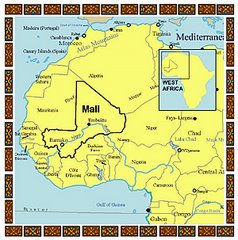
For one year now I have lived in M’Pedougou, a subsistence farming village in the fifth poorest country in the world. I wake up in my mud hut at dawn to fetch water, I hike to the fields with my host family and help them hack the dry Sahelian earth with short-handled hoes, and I try as best I can to help them improve their lot in life. As an ‘Environment’ Peace Corps volunteer in Mali, West Africa, my job is to help people manage their natural resources in both an ecologically and economically sustainable manner.

Mali suffers from several unique distinctions: in addition to being ranked 173rd of 177 countries on the United Nations’ Human Development Index, it also ranks among the worst for gender inequality. Women carry the heaviest load in the struggle to survive in the harsh climate of the Sahel. They wake up before the roosters to collect firewood, heat water for bathing, pound millet and corn into flour in order to cook three meals a day over smoking fires, and when the rains have come they go to the fields to eke out an existence on depleted soils. All of these duties are performed with infants strapped to their backs and several more children in tow.

The United Nations recognizes that in order for rural, agricultural, illiterate societies to develop, women must be given an opportunity to lighten their burden. In villages like M’Pedougou, women are responsible for feeding their families and caring for their children with little access to an independent income. All field crops, such as peanuts or cotton, are sold by the men. All garden produce, such as bananas or tomatoes, are sold by the men. In rural Mali, the sole domain that remains for women is the shea tree.

The shea tree produces a small fruit with an oil-rich nut that women collect, dry, and process to extract butter for cooking, medicinal purposes, and for selling. This income from shea butter pays for children’s clothing and school fees, vegetables and sauce ingredients that provide valuable nutrients, salt, soap, household supplies, and medicine for the women and children.

In recent years, the international market for shea products has expanded, from use as a cocoa butter substitute to pharmaceuticals, leaving Mali (which has the second largest population of shea trees in the world) trailing behind other shea producing countries in West Africa. Malian women traditionally dry the shea nuts by roasting them over a fire, which introduces smoke and carcinogenic compounds which are forbidden by international regulation. According to the NGO ProKarite, ”A lack of product quality standards and technical proficiency of producers has greatly constrained market opportunities for rural producers of shea, particularly in Mali which has long suffered from a reputation as a source of poor-quality shea kernel and shea butter.”

Last year when I was living in Paris I bought a small pot of shea butter in an upscale boutique for 15 Euros. The same quantity sells for 15 cents in M’Pedougou. In order to give at least a fraction of that higher share back to the women who deserve it, many groups and NGOs are working across West Africa. In Mali, USAID (the US Agency for International Development), several local organizations, and the US Peace Corps are working together to provide women with the training and the organizational skills they need to improve Mali’s reputation as a shea producer and to give rural women higher prices for their shea products.

The first step in this process is teaching women how to improve their shea processing techniques, to shift from smoking their nuts to sun-drying them. In my past year as a volunteer, I have participated in several educational meetings and trained my Malian “counterpart” (a farmer in M’Pedougou) how to lead more trainings on improved shea butter production. Together, we have travelled to several local villages and we are poised to organize an area-wide group that will sell improved butter (at higher prices!) next year.

Finally, I was in discussion with my director at the Peace Corps over the difficulty of training illiterate women on something that can’t be demonstrated. At trainings, we must discuss the process in the abstract – as there is no way to collect nuts, wash them, dry them, store them, pound them, and make them into butter in a one-hour meeting with a women’s group. We alighted on the idea of making a training video that could visually demonstrate the process, from start to finish, and enumerate the steps clearly in Bambara (the language I have learned, spoken throughout Mali). Once finished, the video could be used by USAID staff, Peace Corps volunteers, and several NGOs in their regional training efforts. It could be played on laptops, DVD players (frequently found even in small villages!) and projected on screens in larger towns and cities. Finally, the video could be shown on the Malian TV station, ORTM.

As a graduate of the film production program at the University of Southern California, the possibility to use my skills during my Peace Corps service excites me greatly. I have with me in Mali a high-definition video camera, but I lack the means of turning my raw footage into a movie. All I need is a computer and editing software in order to turn my mud hut into a miniature MGM, M’pedouGou Movies (ok, I don’t have electricity, but Sikasso is close).

My own salary as a Peace Corps Volunteer doesn’t include an allowance for new laptops or editing software, so I am asking for donations to help me in this project. My parents are coming to visit me in December. They have offered to deposit checks in my account and to order the computer and bring it to me when they come.

My goal is to raise $3500 to cover the costs. Please donate what you feel you can afford. You can mail checks (payable to Jessica Luna) to:
John Luna
24663 Ervin Rd
Philomath, OR 97370.

In love and light, saying goodbye to the rains and hello to the cool Harmattan winds,
Wishing you peace
Jessie

Making shea butter.
My women's group, who are ready to form a shea butter association.

Wednesday, September 3, 2008

On being a woman

The hitchhikers are barely visible in the dim glow of a rising moon, but we pull over to pick them up. I hop off my bike seat and re-roll my pant leg so it stops catching on my broken pump handle that sticks out. The hitchhikers are two preteen girls, just old enough that their tee-shirts aren’t flat but no older than 12 or 13. They aren’t old enough or lucky enough to be bike owners though, so tonight they decided to walk and hope they could catch a lift on the back rack of some guy’s bicycle. I am with M’Pedougou’s 20-year-old-boy posse, a rowdy pack of testosterone and hormones, all dressed up in their decorated bleached European-style jeans and tight t-shirts. It’s “soiree season” – the time of year when the young men of each village put on a big night of dancing and invite all the surrounding villagers.

The M’Pe posse convinced me to come along, so when we finished our round of tea at my host family’s around 10, a group of 15 or so saddled up and we peddled off into the darkness. I held my flashlight awkwardly gripped on my handlebar, veering around potholes in the dirt path. I noticed that most of the boys were riding blindly, and some of them didn’t even have brakes – they just put their foot on the back wheel to slow down. When we reach the first hitchhikers, the girls hop on side-saddle onto the back rack and then appear impervious to the rattling and bouncing that is making my flashlight look more like a strobe light.

After about 5 miles we reach the water. Under the fresh light of the low full moon, I see currents rippling and the whole posse dismounting to roll up their pant legs. “Sita, roll them up pretty high.” Ok, I think, this time’s as good as any to get schistosomiasis (the water-borne illness because of which we are told to never wade or swim in fresh water). I roll up my pant legs and we forge our way across, picking slowly over the unseen and rocky bottom. One guy tries to show off and ride across, until he hits a rock and falls off and everyone laughs.

We show up at the soiree with wet feet but well warmed up. I ogle a bit at the production. A beat-up old taxi had brought a generator, lights, speakers, and they walled off the schoolyard with whatever burlap sacks or tarps they could find. The lights are surprisingly bright after our quiet ride under the stars, and the speakers bump out fast Cote d’Ivoirian dance anthems. A crowd teems at the entrance, and the M’Pe posse globs on to the amoeba. There are two bouncers at the door taking money and giving tickets – it is CFA 500 to enter, about $1.25, and that includes a soft drink. In one of the few instances where I like sticking out because of my whiteness, they pull me up to the front and usher me through for free (I don’t want a soft drink). Inside, the school desks and tables are arranged in the schoolyard and groups of people are hanging out talking and flirting. It reminds me of a high school dance. When the M’Pe posse finally filters through, we go into the school house to dance. The main room is an inferno, a boiling, dripping, sweaty sauna of a dance party. I get the expected curious looks and stares (what is a white girl doing out here?) but a good share of greetings and waves from the people I know. The Sikasso DJ is a giant of a man (I know immediately he isn’t from a village – no one can get that fat eating corn toh!), and he sidles my way and tries to pull me into a circle and dance with me. Just as quickly, the M’Pe boys circle around and close him out. I smile and think, ah, it’s good to go dancing with 15 brothers who look out for you.

As the night wears on – we move inside and outside as the sweat drenches us and then evaporates in the brisk night air – I notice that there are very few women at the party. It is at least two thirds men, from the age of 12 to 40, with a heavy concentration of 20 year olds. But the girls, that is important, girls, not women, are few, and they are mostly of our hitchhikers’ demographic – preteens and early teens. I think about what I’ve read and heard, that women are married off as early as 12 and not much later than 16, and I stop to wonder if all this really is the equivalent of a high school dance, with the men all looking at these girls as prospective hook-ups or wives or second wives. They even play the requisite slow song now and then and everyone but a few couples rushes outside to cool off (isn’t that familiar?).

I also can’t help but reflect on my own place at this soiree. Ha. I’m the only white person. The only woman. The only college educated person. I’m just an anomaly – a pale, unmarried, childless 24 year-old woman who likes to go dancing. I would expect to feel “out of place” in the situation, but I have come to realize in my Peace Corps service that I am just different here, that I do not have a ‘peer group’ or a social place in this culture. All the women my age are married with three kids and never went to school, so the closest peers I have are the 20-year old guys who make good buddies for drinking tea and forging rivers at 5 in the morning. By the time I crawl into bed the moon had crossed the sky to pass the baton back over to the sun.

__________________________________

My host mom Alimatu and I are out collecting shea nuts one afternoon when I ask about her uterus. In the fall she had sharp pains in her reproductive system and she had gone to several doctors. She says that she and Jakalia (my host dad) had been told that her uterus was spent, just worn out from bearing four very large boys. She says that the doctor told her she shouldn’t have any more children. She stops, and it is just the breeze and the sounds of our nuts plunking into our buckets. So, I ask her, what do you plan to do about it? Are you going to take birth control? She says that she doesn’t want any more kids, that she is tired, and she doesn’t want to risk another pregnancy. But birth control, that is Jakalia’s decision, and he hasn’t said anything to her. I pause. Alimatu, have you talked to him about this? I think if you point out that he doesn’t want you to die, that he wants you to be there to raise your four boys, he might agree to put you on birth control… And we continue collecting nuts, plunk, plunk, and I speculate that rain might come later.

____________________________________

I've heard and read a lot about women's rights... but until now I have never understood how important the 'right' part is, that aspect of freedom, the aspect of choice. The differences between me and Alimatu are many but at the core is that I have choices in my life. I can decide to take birth control if I want to, without consulting anyone. I will decide when and to whom I marry, and if and when I have children. I ride my own bicycle to the soiree because I have economic rights and I can buy my own bike.

But... it isn't a simple picture. I don't know how I feel about this yet, but I know it is anything but simple.

Tuesday, July 29, 2008

One Year


Kama, one of my host family 'little brothers' and a beacon of sunshine. He told his dad that he wanted to drop out of school, so he became a cow herder for three months during the dry season and now he farms.


One full year. The days go by slowly, but the weeks and months have flown by, and now here I am in Bamako welcoming a new group of trainees, telling them stories and assuring them they will survive. It is a fresh dose of perspective to be reminded that only a year ago, I too was struggling to say the most basic phrases, that I thought the food in my homestay was terrible (I look back on it now and say, hey, that was pretty good!), that I was truly a child in terms of my ability to function in this society.


And now... here I am, having passed through the growing pains of adolescence and arrived at adulthood (well, pretty close). I don't have to ask questions about how to say such and such, what's appropriate, how things are done, or what organism is living in my gut. These things feel like second nature to me now (and my amoebas are like well-loved house pets... I feed them well).


The past two months have been the best yet. After months of sweating and waiting for the rains, the sky finally darkened and the village shifted from under the shade of the mango trees to back-breaking labor in the fields. Every morning the women wake up at 4am and trek out in the pitch black to collect the shea nuts that have fallen in the night. By daybreak they have returned, heated water, cooked, and they head out to the fields again, with hoes slung across their shoulders and bowls of food on their heads. Some are lucky enough to have cows, and the men till the fields with cow plows before seeding, but others just hack at the dry crusted earth with their sculpted, weathered muscles, and little by little they plant hectare after hectare of peanuts, rice, sorghum, millet, and corn. Once the seed is in the ground, the first field is already weed-infested, and the frenzy of weeding begins. It is truly back-breaking labor, and I marvel at how they tackle such a seemingly hopeless task(eleven hectares of corn stretches for a loooong way).
Last week my host dad 'hired' the women's group of my family (the Bengali women) to come weed his field for a day - 40 women for an entire day for about 10 US dollars. Wow. The old women came with their 'chichira' shaker gourds and sang, and women would rise to dance and sing as they hoed, drenched in dirt and sweat. Abdouleye told me that when he was a kid it was always like that, that when people went to plant, the drums came too, and their was dancing and singing in order to urge people along in their work. But, he says, the cow plow came and it is hard to play drums, and that the tradition has mostly disapeared. I can't help but question what constitutes progress Yes, the cow plow is good, I won't deny that, but it saddens me to see how quickly their society is being overtaken by new technology - at such a speed that they don't have time to adjust their cultural practices... they just get lost.
Abdouleye (my work partner) and I have pushed full steam ahead with field experiments. Several farmers are trying out new sorghum varieties in controlled plots, some are putting urine on corn (a free source of nitrogen), and one farmer just planted an alley cropping trial (nitrogen fixing trees in a crop field). I have also taught my womens group about Moringa, a tree whose leaves are rich in vitamins, iron, and calcium, and they have planted them throughout the village. So, slowly, slowly, I feel like I am starting to be useful.
Yaya and Abdouleye, my two best friends in M'Pedougou. Yaya measures the rain every day for logging in our sorghum trial notebook. This is in the middle of his peanut field.

Abdouleye with a jug of watered down pee, getting ready to go "water" our corn test plot. Hmmm, nitrogen.
--------------------------------
On Language

Speaking a foreign language means learning to see the world in a new way. If it is true that “I think, therefore I am,” than thinking lays the very foundation of ‘being.’ Our patterns of thinking are, in turn, deeply trained by the linguistic tools that we use to organize our perceptions of the world around us. As my Bambara progresses, I realize how my mental habits are shifting as well. Significantly, there is no word for “late.”

Some fun ones -
I forgot – A bora n kono – It was inside me, it left
End of the month – kalo ka sa = death of the moon
Fruit – yiriden = tree children
Airport – pankurunjiginyoro = jumping boat landing place
To do physical activity/sports – farikolo nyenaje = bring body bones together for amusement
To spit – dajibo = to put out mouth water
N t’a don = I don’t know, I don’t enter, I don’t wear it, It’s mine
Yele - to smile, to laugh, to open, to go up, and light

And I realized just how mixed up the word order can get. Learning French was hard because of the masculine feminine nonsense, but at least the word order stays relatively similar – Not so in Bambara. The sentence ‘N be na mangora ja cogo kura jira dugo muso ma,’ translates word for word: I am coming mango dry way new show village women to.

On White Skin

I have yet to silence the complete pandemonium of emotions – anger, confusion, exasperation, and sadness – that arises every time the glowing apparition of my skin falls under the gaze of Malian children. It is the soundtrack to my existence: a high-pitched chipmunk warble of a broken record spinning the same three syllables into eternity, “Tubabu! Tubabu! Tubabu!” Occasionally the record progresses into loud nasal “Ca vaaa? Ca vaaa? Bon soooir,” as they say good evening at 10 o’clock in the morning.
Some days I eke out a smile and a soft greeting, “Aw ni che.”Some days I grit my teeth, avert eye contact, and hope that if I ignore them maybe they’ll go away. This only makes it grow louder.
Some days I burst a seam and I call back “My name is not Tubabu!” in Bambara.

The word Tubab comes from the Arabic word for doctor – tubib. So. I guess I’m a doctor. I come bearing news of washing-hands-with-soap and beans-beans-the-magical-fruit. Amazing how these two things could in fact produce a significant impact on their well-being. The Tubab-shouting children are only one group, the excited, eager, swarming kind. The others are no less curious, but they stay silent behind shy, shell-shocked eyes as they gape unashamedly at the wonder of my skin. Some, in rural villages, take a quick appraisal of this ghost in the shape of a woman and run screaming in horror. I’ve even seen one trip and fall on his flight from my ghastly presence.

If white children had never before seen black people, would they behave in the same way? If so, why do children respond this way? Why do kids get so outrageously excited by me? Why do I get so annoyed? What role does the history of French colonization play in all of this? Do they have a persisting "pyschological colonization" that manifests as an inferiority complex?

I reflect on these thoughts and I try to understand the complexities of my reactions. I have a quote on my wall that reads:
Treat every person you meet
as if they have a sign around their neck that says
‘Make me feel important.’

So there I am on my bicycle riding home from Sikasso through packs of chanting children…. Sighing and trying to smile and remain relaxed and to practice unconditional love. I can’t change Malians, I can only change my reaction to them ("if you want to make the world a better place, take a look at yourself and then make the change”). Yet if I could change one thing, it would be to hide my skin. I guess I will work on that patience thing some more.
And MORE pictures are at

http://www.facebook.com/album.php?aid=2265565&l=68f84&id=3408340

Monday, June 2, 2008

Watering the Fetishes

We're on the cusp of rainy season. The heat builds up until we think we're going to suffocate, and then the Western sky boils black and comes riding in on sheets of wind. I run inside and watch eagerly as the rain pummels the parched, thirsty earth, giving life, giving food, giving green.


M'Pedougou is not a Muslim village. They call themselves "josonnaw," which translates to "fetish waterers." It is what Westerners loosely lump into the category of animism. What I've gathered is that they give sacrifices to the genies and the ancestors, and each year they kick off rainy season with a giant village festival to give offerings and to dance until they ancestors too must get tired from watching. It is called a "dugu son," which might mean "watering the village," and people come from villages near and far to take part in the fun.

DAY 1

We've finished hauling buckets and buckets of water (carefully perched upon our heads as we weave through the maze of pathways connecting pump and hut), and the rice and sauce have been cooked in the light of a hazy orange sunset. My host mom Alimatu thrusts a bowl of rice at me and says "Wu si!", lets go! My host moms, host sister Nawa and I each take a bowl and scuttle down the road that winds past the mango groves and towards the great sacred tree where the genies live. They gracefully balance their bowls atop their heads, hips swaying, heads perfectly motionless, while I must hold on to mine with a hand. Other groups of women and children join us, and as we reach the mango groves, more women come running towards us, their bare feet flapping on the dusty earth, their mouths carved open into giant grins. They grab handfuls of rice out of our bowls and eat some, then throw some into the air. We pick up the pace and snake our way along the edge of the old cotton field towards the tree.

The tree is a giant, its roots curling up out of the ground and its pale skin stretching skyward before slender arms emerge and twist and tangle into each other. At its base, we approach one by one and throw our few remaining handfuls of rice (most of it having been eaten on the way there) upon its smooth, exposed roots. We say our prayers to the ancestors and to the genies, "May we have a good rainy season," "May all of our children be fed," then turn and work our way upstream through the incoming swarms of women, grabbing handfuls of rice out of their bowls and sharing smiles and moments of laughter.
Back in our compound, we fill more bowls of rice and take them to the Bengaly family meeting house, placing them in the midst of a circle of people. Dusk has swept the harsh African sun past the horizon, but a few men hold up flashlights, so I can make out some old men sitting around with a crate of chickens beside them. One man starts uttering blessings in Senoufo and another slits a chicken's throat over a calabash of fetishes and other mysterious, secret-society things. Once the blood has drained, he tosses the limp creature into the middle of the circle, where the crowd watches in anticipation. The scrawny bird lays still for a moment, then its body leaps off the ground, flailing and flopping. There is no "running around" of the proverbial chicken with its head cut off, as these chickens are too weak to run in the post-life. The best they can do is flap their wings and make a few desperate hops. After watching about a dozen chickens die, some of whom manage to flop their way into the bowls of rice, the crowd lets out a roar and the women start shaking their chichara gourds, and a few burst into song. I turn to my host mom, "Mun kera?" what happened?. She responds, "It landed on its back. If it lands on its back it is a good sign, it means it has pleased the ancestors." ah. of course.

DAY 2

I get up late, exhausted by the night-after-night of balafon dancing. My legs hurt, I've got ghiardia again, and a cold. But eh, that's life here, so I haul water from the pump, water my tree nursery, take a bucket bath, and head over to my host family's house. Today is the 'big day.' All the women in my extended family bought matching fabric, so today we gather and don our outfits for the first time. In the distance we can hear the deep echo of the "bum-ba" drum, literally 'big boom,' a fitting name I think. Two black masked creatures appear - hunched over like old men, leaning on canes, dancing a slow knee-lifting side step. Wiry 'hair' flows down from the masks over their backs, and someone sticks corn cobs into the extended carved mouths. One of them apparently has bad vision; he's got funky black glasses perched on his pointed nose. They chase the swarms of children, who run screaming in terror and delight.


A balafon mysteriously appears and soon the drums are wailing. After a song or so they pick up, the instruments float up onto the tops of womens' heads, and the whole crowd is moving along towards the sacred trees. Behind us more people are gathering at the Boom-ba.


Once we reach the sacred grove, tucked into the lush greenery by a stream, the musicians set up post and start pounding out rhythms, and groups of women tap-shuffle their flip-flopped feet, kicking up clouds of dust that we cough on and laugh at.


We don't spend long before the instruments are hoisted up again. There are still hordes of new musicians and dancers arriving, but we're the first wave, so we move out through the forest, traipsing across dried out crop fields, picking over millet and sorghum stalks. We pass by the giant tree, give it our blessings, and move into the fields to dance.

Like transient worshippers, we soon pick up and wind single-file back towards M'Pedougou, skirting around the mango groves towards the dugutigi's house (the village chief). We all remove our head wraps and bow before the chief, who is blind and mostly deaf, but still a smiley old man who showers us with blessings and chews on bitter kola nuts. We dance for him and then dance outside as new groups move in, dancing until our feet hurt and we're thirsty and tired. Women start slipping away, to get water, to wash, to cook the evening meal of rice and sauce. The sounds of pestles pounding sprinkles the air, already thick with shaking gourds, hands thumping leather, and agile drum sticks dancing on the resonant planks of the balafon.

DAY 3

In the morning, again exhausted, I come to greet my host moms. We sit down to eat rice and sauce, and Fatimata seems tired. She has been pregnant for months, and I wonder at how she got through all the festivities. We don't talk much, and then when we have finished eating she says "A be so kono," it (or he or she) is in the house." I look at her blankly. She nods at the house. I look at her stomach, and a wave of comprehension slides over me. "FATIMATA!" I shriek, "You gave birth!" She nods, and smiles towards her hut. I leap up, then slow down and cautiously enter the dark hut, pushing back the curtain in her door. I look on her bed, seeing only piles of clothes, pieces of fabric. I make out a bundle, then a tiny face, its eyes closed, its face scrunching up as it stretches. I sit down softly. The doorway darkens and Fatimata enters. I look at her tired slender body and the miniscule human being, and she picks him up and places him in my lap. She shrugs, profers a wan smile, and I wonder what she's thinking. What does this kid mean to her? Her eldest son is 18, a grown man, and here she is with a newborn, its fingernails barely visible, getting ready to nurse it into toddlerhood and strap it on her back as she heads out to the fields.


Soon it will be time to plant. To watch the skys and hope for rain, to sow the seeds for next year's food by the force of muscle and a hoe. To hope that this year will be better than the last.

MORE PHOTOS
http://www.facebook.com/album.php?aid=2239022&l=2b1df&id=3408340