There are a lot of cliches regarding Africa and what one learns while living on this continent. One of the greatest, perhaps because of its inherent truth, posits that time moves differently over here. Things take longer. People aren't as hurried. Patience, a good deal of it, is a recommended strategy for coping with daily life.
Three hours by the roadside and I'm still there trying to catch a "bush taxi" into Sikasso. The late afternoon sun refuses to move faster; it hangs motionless, its heat waves burning into my sweat-soaked skin. I look at my watch, it too seems suspended. I swat some flies from my brow, and my mind drifts....
I watch my thoughts and where they go, both in space and time. I notice how hard it is to wait in the present moment, to just sit and be, to not be expectant. Instead, my thoughts meander into the past, to experiences and to people. More commonly though, they make forays to the future - conjuring up alternate realities and possible lives I may lead. It is such a human tendency to think about what if's to escape the present. And yet, the present moment is all that is. In these moments of stillness, with the sun, the flies, the very realness of just being alone and waiting, time does indeed take on a new meaning.
West African International Time; learning to wait.
Tuesday, September 18, 2007

Homestay photos


 I gave the farewell speech in Bambara to our host village. A lot of blessings!
 And here is the link to more photos that I posted:
http://usc.facebook.com/album.php?aid=2169812&l=51b31&id=3408340
Friday, September 7, 2007
Pictures from Sikasso!
 A few photos from my site visit -
I apologize for the lack of pictures... my
camera disappeared. I am relying right
now on my friend's pictures. The one to
the right is the village landscape near
Sikasso; this is the village 3km away
from mine and looks quite similar.
Very lush right now because it is
the rainy season.

Here I am in my hammock outside
my house, which will be my HOME
for two years! I plan to paint
and plant sunflowers.
 And this is the main hangout of my village - my host dad's bike repair station/ butiki on the side of the road. I will spend a lot of time here in the months... er, years to come trying to understand Senufo and drinking tea.
Thursday, September 6, 2007
Back in Homestay - Baobob leaves
I come back from the daily grind of Bambara class, making a wide arc around the compound of children whose daily goal is to swarm the "tubabus" (white people) and pester us to take photos. I greet my way along the edge of the rice fields, dodging piles of trash and donkey shit. I duck through the arched door into my concession and greet my family; the greetings feel natural and easy now.
My host mom gives me my bucket of water and I bathe, peering over the top of my nyegen to see the kids pulling out the TV and the bench to watch the evening installment of "The Heart of Sin," a Brazilian soap opera dubbed into French and wildly popular. They plug the TV into a battery and fiddle around with the reception and sardine themselves onto the bench to watch surfers and scandalously dressed women. I eat my bowl of mushy sorghum stuff with an oily sauce, study for a bit, then go inside and read with my lantern.
I'm woken from my pages by women's voices outside my screen door, gentle but multiplying. I step out to a scene of more than a dozen women circled around a giant pile of Baobab tree branches, glowing in the blue halo cast by a fluorescent bulb that is plugged into the same battery that so faithfully powers the TV each night. The women are muttering, chatting, laughing, recounting the day, and still working at 9:00pm. They are stripping the leaves and placing them in buckets. I ask if I can help, and after the usual dose of laughter that follows anything I say in Bambara (I am a natural comedian in Bambara, just saying 'how are you' can sometimes elicit peels of laughter), they widen the circle and I start stripping leaves alongside them. I wonder how much the battery costs and how long it lasts; I wonder how my family affords it and how they bought the TV. What do they sell?
But back to leaf stripping. I don't watch the leaves so much as the women. I notice they are wearing nicer clothes than I usually see them going to the fields in; they glow in a panoply of colors and textures and patterns, wrapping, draping, with intricate necklines and sleeves and head wraps. I marvel at how beautiful they are, their smiles and their muscular arms carved from years of pounding grain and washing and hoeing. Many of the women have their babies wrapped around their backs as they work. I think West African women should have been marsupials, but they make up for their lack of a pouch by strapping the little ones onto their backs with a piece of cloth. They do anything with baby in tow.
When the leaves are finally stripped, the women begin chopping them into fine pieces to make into sauce. I wonder how the finished product is going to be divided; who gathered the branches? Who brought them back? How will they know who did more work than others? As I am wondering this I also notice that the leaf stripping and chopping almost seem like a background detail, a setting to facilitate the primary activity: socializing. When a woman is telling a story and especially animated she will stop her cutting and gesture and laugh. The stars are bright; the milky way seems almost like a cloud stretching across the sky, and they are in no rush to finish. There is no time clock to punch in and punch out; no boss measuring productivity or performance, just the rhythm of existence. The leaves aren't measured and divied and horded; they are shared among the women. It will take me some time to grasp the concept that the measuring stick of value here is community, not the individual.
The next day's lunch is a delicious dark green sauce; I compliment my host mom and relish the rare treat of Baobob leaves.
My host mom gives me my bucket of water and I bathe, peering over the top of my nyegen to see the kids pulling out the TV and the bench to watch the evening installment of "The Heart of Sin," a Brazilian soap opera dubbed into French and wildly popular. They plug the TV into a battery and fiddle around with the reception and sardine themselves onto the bench to watch surfers and scandalously dressed women. I eat my bowl of mushy sorghum stuff with an oily sauce, study for a bit, then go inside and read with my lantern.
I'm woken from my pages by women's voices outside my screen door, gentle but multiplying. I step out to a scene of more than a dozen women circled around a giant pile of Baobab tree branches, glowing in the blue halo cast by a fluorescent bulb that is plugged into the same battery that so faithfully powers the TV each night. The women are muttering, chatting, laughing, recounting the day, and still working at 9:00pm. They are stripping the leaves and placing them in buckets. I ask if I can help, and after the usual dose of laughter that follows anything I say in Bambara (I am a natural comedian in Bambara, just saying 'how are you' can sometimes elicit peels of laughter), they widen the circle and I start stripping leaves alongside them. I wonder how much the battery costs and how long it lasts; I wonder how my family affords it and how they bought the TV. What do they sell?
But back to leaf stripping. I don't watch the leaves so much as the women. I notice they are wearing nicer clothes than I usually see them going to the fields in; they glow in a panoply of colors and textures and patterns, wrapping, draping, with intricate necklines and sleeves and head wraps. I marvel at how beautiful they are, their smiles and their muscular arms carved from years of pounding grain and washing and hoeing. Many of the women have their babies wrapped around their backs as they work. I think West African women should have been marsupials, but they make up for their lack of a pouch by strapping the little ones onto their backs with a piece of cloth. They do anything with baby in tow.
When the leaves are finally stripped, the women begin chopping them into fine pieces to make into sauce. I wonder how the finished product is going to be divided; who gathered the branches? Who brought them back? How will they know who did more work than others? As I am wondering this I also notice that the leaf stripping and chopping almost seem like a background detail, a setting to facilitate the primary activity: socializing. When a woman is telling a story and especially animated she will stop her cutting and gesture and laugh. The stars are bright; the milky way seems almost like a cloud stretching across the sky, and they are in no rush to finish. There is no time clock to punch in and punch out; no boss measuring productivity or performance, just the rhythm of existence. The leaves aren't measured and divied and horded; they are shared among the women. It will take me some time to grasp the concept that the measuring stick of value here is community, not the individual.
The next day's lunch is a delicious dark green sauce; I compliment my host mom and relish the rare treat of Baobob leaves.

Thursday, August 30, 2007
a new name : Sita Bengaly
Most of us like to get a tester spoon of that chocolate hazelnut gelato before we buy it; to run the flavor over the tongue and decide yes, I do in fact want to invest in a more prolonged experience. The Peace Corps apparently recognizes this human tendency and sent all the trainees to our real sites this past week to get a sample of where we will be living for the next two years of our lives.
So last Tuesday I met with Abdouleye, a farmer from my region who will serve as my "homologue," a go-to-person and guide to help me work in agriculture in my region. He is a slight man with a furrowed brow that quickly flattens into a grin. We went to the bus station together and sat on some old crates to wait a few hours for the bus to fill. The bus station swarms with men and women balancing huge baskets and platters of fried cakes, bananas, toothpaste, jewelry and radios, all teetering with impossible grace on the tops of their heads. Finally the bus "boiled" (Bambara is a language that I have dubbed a "homonymic whirlpool" because each word has twenty meanings. The word wuli means to plow a field, to boil water, to stand up, to wake up, and for a bus to leave), and we sat in cramped seats, sweating in the stagnant air for seven hours until we reached our village in the South East of Mali: M'Pedougou.
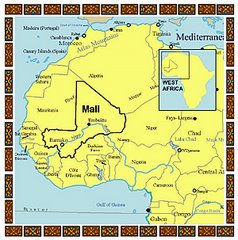
M'Pedougou is a village of about 650 people of the Senufo ethnic group, situated on a main road; straddling the vein of modernity but still firmly rooted in tradition. When I arrived, I met my host family, Jakilia Bengaly and his three wives, beautiful people with big white smiles and thick Senufo accents that I don't understand. They gave me my new name: Sita Bengaly, and we sat out by the roadside in front of Jakilia's little butiki (store). Next they took me to my house, weaving through the village on a little path past thatched huts and gardens and big trees. There was my house on the edge of town: a mud brick cottage with a thatched structure outside for shade. Big vines and flowers fill my yard, and I plunked down in my hammock, realizing that this is my new HOME. I went to the pump and got water, set up my mosquito net, and went to meander in the village.
It turns out that well, Senufo people speak Senufo. Most of them have learned Bambara as a second language, but they speak Senufo amongst themselves and when given the choice. I spent a good portion of my week in village sitting around listening to the crazy sounds of Senufo and wondering if I will ever be able to learn a language that sounds like Chinese, but that has no written materials for me to learn from. We'll see. I will try.
The majority of the villagers are subsistence farmers farming millet, sorghum, corn, okra and peanuts. My goal as a volunteer will be to help them develop better gardening and farming techniques, increased compost production, and to do what I can to enable them to improve their quality of life, in whatever capacity I can. At this point I still have no idea what I will be doing, concretely, when I get to village and have no structure, no "job," nothing but the sunrise and the sunset to structure my day around. It will be a radical change, that's what I do know.
So last Tuesday I met with Abdouleye, a farmer from my region who will serve as my "homologue," a go-to-person and guide to help me work in agriculture in my region. He is a slight man with a furrowed brow that quickly flattens into a grin. We went to the bus station together and sat on some old crates to wait a few hours for the bus to fill. The bus station swarms with men and women balancing huge baskets and platters of fried cakes, bananas, toothpaste, jewelry and radios, all teetering with impossible grace on the tops of their heads. Finally the bus "boiled" (Bambara is a language that I have dubbed a "homonymic whirlpool" because each word has twenty meanings. The word wuli means to plow a field, to boil water, to stand up, to wake up, and for a bus to leave), and we sat in cramped seats, sweating in the stagnant air for seven hours until we reached our village in the South East of Mali: M'Pedougou.
M'Pedougou is a village of about 650 people of the Senufo ethnic group, situated on a main road; straddling the vein of modernity but still firmly rooted in tradition. When I arrived, I met my host family, Jakilia Bengaly and his three wives, beautiful people with big white smiles and thick Senufo accents that I don't understand. They gave me my new name: Sita Bengaly, and we sat out by the roadside in front of Jakilia's little butiki (store). Next they took me to my house, weaving through the village on a little path past thatched huts and gardens and big trees. There was my house on the edge of town: a mud brick cottage with a thatched structure outside for shade. Big vines and flowers fill my yard, and I plunked down in my hammock, realizing that this is my new HOME. I went to the pump and got water, set up my mosquito net, and went to meander in the village.
It turns out that well, Senufo people speak Senufo. Most of them have learned Bambara as a second language, but they speak Senufo amongst themselves and when given the choice. I spent a good portion of my week in village sitting around listening to the crazy sounds of Senufo and wondering if I will ever be able to learn a language that sounds like Chinese, but that has no written materials for me to learn from. We'll see. I will try.
The majority of the villagers are subsistence farmers farming millet, sorghum, corn, okra and peanuts. My goal as a volunteer will be to help them develop better gardening and farming techniques, increased compost production, and to do what I can to enable them to improve their quality of life, in whatever capacity I can. At this point I still have no idea what I will be doing, concretely, when I get to village and have no structure, no "job," nothing but the sunrise and the sunset to structure my day around. It will be a radical change, that's what I do know.
Wednesday, August 8, 2007
Malian artwork
 This is Youssouf, a guy who lives next to my classroom in my host village. I am working on convincing him to trade his bicycle for my "flashy" Trek mountain bike.
Tuesday, August 7, 2007
Village life begins
Village life begins with the firing of rifles. When I arrive with four other volunteers at the end of a muddy road, the town elders come to greet us and fire shots into the air to announce our arrival. People emerge and line the path with color, music and smiles, handshakes and drumbeats. We wind our way into the heart of the village and gather around the grand tree, where we greet the chief and gave him a gift of kola nuts. Then the balafon players woo us into the center of the square and we dance, pulsing forward and backward in lines, women only, exchanging neck scarves, with hundreds of eyes fixed on our every move.
My host mother Kajatu greets me, a strong and stout woman with crinkly eyes that are always smiling. A small crowd of children takes my things and leads me through the warren of thatched huts and dirt paths to our celebration lunch with all the volunteers; we wash our hands with water in tin cans and then gather around large communal bowls. I eat a goat's stomach, wave at the flies, and smile a lot.
The first night I'm exhausted, and by 9 pm I'm splayed under my mosquito net on a scratchy sheet, listening to the sound of a blaring radio, a tribe of crickets that colonize my ceiling, and intermittent donkey brays that pierce through my screen door. My body is drenched in sweat; the air is stagnant and humid. I click on my headlamp and root around until I find my earplugs. These two cylindrical pieces of yellow styrofoam are worth more than the castle of Versailles. I finally fall to sleep.
In the morning Kajatu brings me a bucket of warm water, and I go to the nyegen and bath myself, watching the rain clouds swirling in and listening to the "thunk thunk" rhythm of the women pounding millet throughout the village. The thunks are punctuated by claps, *the women let go of the stick and clap while the stick continues to rise, then they catch the stick again and continue to pound. I am in AWE of this skill and have embarassed myself repeatedly in attempts to acquire it*. I sit in the dirt courtyard between our huts and eat some white bread and drink sugary tea for breakfast, then go to my teacher's hut for my daily routine of Bambara class. The session is soon drowned out by claps of thunder and torrential rain, and we move from our leaky thatched "gwa" (open-sided hangar) to the teacher's bedroom, and continue our lesson sitting on the concrete floor, dimly lit by a small window and a lantern.
For 10 days now I have spent all day learning Bambara, from 8 to 6, with a break in the middle where I go home for lunch. On the way home, I pass a compound where children come streaming out yelling "Bonjore! Bonjore! Bonjore!" and shake my hand, then run to far end and repeat the routine a minute later. It has become an 8-times a day ritual (twice on the way there, twice on the way back, twice on the way there, twice on the way back...). The people of the village are incredibly warm and friendly, and greetings are a very important part of the culture. Each morning I have to greet all the elders in my compound (a family of at least 40 people), inquire about health, how they spent the night, their family, and then give them blessings for the upcoming day. It can be tedious, but I also enjoy the priority of human-to-human engagement. I can't imagine walking down the street in the United States and greeting every person that I pass and asking them if their family is doing well.
One of the hardest things we have learned so far is how to bargain at the market. Last Monday we went to the nearby village and practiced our so-called language "skills." The problem of buying things here is that they refer to FIVE West African Francs as ONE when they tell you the price. Here is a nice example of me buying bananas: (in Bambara)
Me: Hello, how are you? How is your family? How was the night? How are your children?
Seller: Hello, I'm fine. Peace only. Peace only. How are you? How is your family??etc.
Me: Bananas how much?Seller: Bananas twenty twenty.
*oh, they repeat the price? But does this mean 20 bananas for 20? Or a pile for 20? Or 1 for 20? And is the twenty TWENTY, or do I need to times that by 5?*
long pause
Me: Give me 15 bananas.
Seller: hundred two and ten forty
*.... ok, 240, that times 5, ok, that's almost 1000, ok, I'll give him 1000.*
LOTS OF CONFUSION.... finally I walk away with some bananas and possibly the right amount of change. I don't know.
I saw the most beautiful sunset of my life the other night. Two vibrant double rainbows in the East and a molten sky in the West that bathed the earth in yellow light. It was surreal, magical. I spend most evenings sitting in my courtyard while my little brothers watch a Brazilian soap opera dubbed into French, while I study and try to put together basic sentences. I make a fool of myself all the time and get laughed at a lot, but that is part of this process. I like to say very simple descriptive sentences "I am brushing my teeth now with a toothbrush," and when someone understands me it is a big victory for the day.
My host mother Kajatu greets me, a strong and stout woman with crinkly eyes that are always smiling. A small crowd of children takes my things and leads me through the warren of thatched huts and dirt paths to our celebration lunch with all the volunteers; we wash our hands with water in tin cans and then gather around large communal bowls. I eat a goat's stomach, wave at the flies, and smile a lot.
The first night I'm exhausted, and by 9 pm I'm splayed under my mosquito net on a scratchy sheet, listening to the sound of a blaring radio, a tribe of crickets that colonize my ceiling, and intermittent donkey brays that pierce through my screen door. My body is drenched in sweat; the air is stagnant and humid. I click on my headlamp and root around until I find my earplugs. These two cylindrical pieces of yellow styrofoam are worth more than the castle of Versailles. I finally fall to sleep.
In the morning Kajatu brings me a bucket of warm water, and I go to the nyegen and bath myself, watching the rain clouds swirling in and listening to the "thunk thunk" rhythm of the women pounding millet throughout the village. The thunks are punctuated by claps, *the women let go of the stick and clap while the stick continues to rise, then they catch the stick again and continue to pound. I am in AWE of this skill and have embarassed myself repeatedly in attempts to acquire it*. I sit in the dirt courtyard between our huts and eat some white bread and drink sugary tea for breakfast, then go to my teacher's hut for my daily routine of Bambara class. The session is soon drowned out by claps of thunder and torrential rain, and we move from our leaky thatched "gwa" (open-sided hangar) to the teacher's bedroom, and continue our lesson sitting on the concrete floor, dimly lit by a small window and a lantern.
For 10 days now I have spent all day learning Bambara, from 8 to 6, with a break in the middle where I go home for lunch. On the way home, I pass a compound where children come streaming out yelling "Bonjore! Bonjore! Bonjore!" and shake my hand, then run to far end and repeat the routine a minute later. It has become an 8-times a day ritual (twice on the way there, twice on the way back, twice on the way there, twice on the way back...). The people of the village are incredibly warm and friendly, and greetings are a very important part of the culture. Each morning I have to greet all the elders in my compound (a family of at least 40 people), inquire about health, how they spent the night, their family, and then give them blessings for the upcoming day. It can be tedious, but I also enjoy the priority of human-to-human engagement. I can't imagine walking down the street in the United States and greeting every person that I pass and asking them if their family is doing well.
One of the hardest things we have learned so far is how to bargain at the market. Last Monday we went to the nearby village and practiced our so-called language "skills." The problem of buying things here is that they refer to FIVE West African Francs as ONE when they tell you the price. Here is a nice example of me buying bananas: (in Bambara)
Me: Hello, how are you? How is your family? How was the night? How are your children?
Seller: Hello, I'm fine. Peace only. Peace only. How are you? How is your family??etc.
Me: Bananas how much?Seller: Bananas twenty twenty.
*oh, they repeat the price? But does this mean 20 bananas for 20? Or a pile for 20? Or 1 for 20? And is the twenty TWENTY, or do I need to times that by 5?*
long pause
Me: Give me 15 bananas.
Seller: hundred two and ten forty
*.... ok, 240, that times 5, ok, that's almost 1000, ok, I'll give him 1000.*
LOTS OF CONFUSION.... finally I walk away with some bananas and possibly the right amount of change. I don't know.
I saw the most beautiful sunset of my life the other night. Two vibrant double rainbows in the East and a molten sky in the West that bathed the earth in yellow light. It was surreal, magical. I spend most evenings sitting in my courtyard while my little brothers watch a Brazilian soap opera dubbed into French, while I study and try to put together basic sentences. I make a fool of myself all the time and get laughed at a lot, but that is part of this process. I like to say very simple descriptive sentences "I am brushing my teeth now with a toothbrush," and when someone understands me it is a big victory for the day.
Subscribe to:
Posts (Atom)